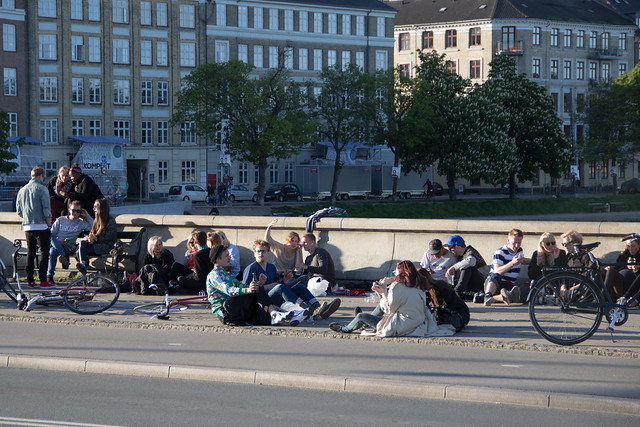
Having formally studied the topic of spiritual formation, someone asked me recently, "Are you a spiritual director?" I was not sure how to answer that question. I spend a lot of time with people talking about their spiritual lives. Often I feel like what I do fits into any one one of those titles. One of the reasons I don't have a business card is that I don't know what to put on it. I think I might just put my name and email address.
Going from last to first titles, here are my thoughts:
Counselor: One of my friends was a very busy wife and mother when she decided to earn her masters degree in counseling. She studied long and hard. She also put in the time and energy to gain certification. She is a professional. She meets weekly with clients, attends professional conferences, and reads extensively so she can really serve her clients. She is my friend and when we meet we often discuss clinical issues. I have learned a lot about psychotherapy from her.
Disciple-maker: I originally listed discipler not disciple-maker, but a squiggly red line appeared underneath the word as I expected since discipler is not a word. Dallas Willard was one of the people who used the word apprentice to describe a person who is following Jesus as well as looking to a more experienced believer for leadership and training. I asked Google, "What is the name of the person who trains an apprentice?" I did not find an answer but I did notice that the contemporary term for an apprentice is intern. I use the phrase disciple-maker because disciple is a biblical word and my profession (my life?) has revolved around the Bible. Jesus' last command was, "Go and make disciples......" (Matthew 28: 19,20).
A few years ago I met a young woman who had recently decided to follow Christ. She asked me to disciple her. Every Wednesday night she came over to my home and we sat together, going over different aspects of the Christian life. She did not shadow me as an apprentice might. I hoped I was encouraging her to "shadow Christ" each day. She was like a "dry sponge," very eager to learn. There was a high degree of accountability in our relationships that she put on herself. She always did homework before our times together. I saw this relationship as making a disciple of Jesus.
Mentor: I will use the above young lady as an example of the protege-mentor relationship. At this time in our friendship....momentary diversion: (She is a dear friend as most people I interact with become a friend. Remember an extrovert has MANY FRIENDS and I consider them all special. Yes, they can ALL be special.) At this time in our friendship, our relationship is not so much about the basics of the Christian life as now she asks questions about specific skills of ministering and serving others. She does ask good questions but I also share ideas and thoughts with her that are more directive.
Coach: Coaching is really a rather new concept in Christian circles. I think the idea is relatively new in business circles as well. There are all kinds of opportunities to learn to coach and become certified so that a person can make big bucks coaching. I know of a man who charges $400/hour to coach in the business context. Coaching (note this is not athletic coaching; that kind of coaching is more directive) has these two basic characteristics: The coachee (not a word, try again), learner, student directs the sessions; The coach's skill is in asking the right questions and listening so that the plan for change comes from the learner and not the coach.
I am in the role of coach with a very capable and mature woman now. She was selected for coaching for her own development personally as well as for her contribution to the organization she works for. I am a bit of a novice so the coaching questions don't come naturally but I am learning.
Spiritual director: I've been a follower of Jesus for forty years but only heard of a spiritual direction ten years ago while I studied in a spiritual formation degree program at a seminary. Spiritual directors have been active in Catholicism, my spiritual heritage, for centuries although I'd never heard of a spiritual director. Nuns and priests engaged and acted as spiritual directors but spiritual directors did not really operate in the church at large. What makes a spiritual director different from all the above? First, spiritual directors target our human orientation of independence from God and others and our proclivity to sin. I hesitate writing sin only because at this time in history, people tend to dismiss the concept of sin. We all have the propensity for self absorption, rebellion, stubbornness, gossip, anger, harsh words. I could go on but all those things are sin. And the word sin is in the Bible.
Spiritual directors do not solve psychological problems per se. Even though some Christian counselors have moved away from counseling in the clinically sense and only practice spiritual direction, I think there is still a need for counselors. I have been in situations when I knew that the dysfunction was beyond anything I could do except pray for the individual.
A spiritual director's hope is to guide the person to listen to the Holy Spirit, through the Bible, through the still small voice of the Lord, and even through words of the person's community. A mentor gives his or her opinion, teaches and trains. A spiritual director must be a person who listens more than speaks, prays more than asks good questions, and directs the person toward a greater intimacy with God.
A coach must be trained to listen and ask astute questions to help a person grow personally and professionally. A spiritual director anticipates growth for his or her client (not really a good word but directee is not a word). However the growth may not be quickly or easily discernible because the transformation is between the person and God.
I had a number of sessions with a spiritual director. The woman appeared to have a deep relationship with God. She had walked with God many years and that alone attracted me. We had very different personalities and theological backgrounds.
Can anyone be a spiritual director? I met a man who had been a pastor, had theological training and decided to hang a shingle, set a fee structure, make a business card and become a spiritual director. Who is or should be a spiritual director? A spiritual director can be described as: a person who has an cherished and enduring history with God; a follower of Jesus with a thorough and ever growing understanding of the Bible; a thinking and discerning person with a steadfast prayer life; and a person with an almost burning desire to encourage people toward an understanding that God as we know Him in Trinity truly is personal, loving, gracious and good.
Spiritual formation for extroverts...but all personality types most welcome!
Tuesday, February 3, 2015
Tuesday, September 9, 2014
A blog about silence, conversation and culture-not really about spiritual formation but...
This young blogger shares some good thoughts on silence as well as culture. I have often wondered about personality type in terms of culture. His blog post would suggest that personality type, specifically the extrovert and introvert dichotomy, might be more linked to culture than the way a person is wired.
He is speaking about silence in the context of conversation..... not all aspects of silence such as having a time of fasting from words or a day of silence for the purpose of reflection.
I've bolded a few of his statements that might be considered general and also made some comments in italics and red
http://virtualwayfarer.com/nordic-conversations-are-different/
In terms of spiritual formation, often those who teach on prayer make the point that prayer is not a conversation with God unless there is silence for God to speak to one's heart and spirit. But is prayer (in biblical teaching ) a conversation with God or simply His children sharing our hearts, burdens, requests with Him? Was prayer ever meant to be a conversation with God like we'd have with another human being?
I did a brief key word search on Bible Gateway, just the word "prayer." 154 results. Kind of amazed.....seems like most of the verses implied prayer is not a conversation with God in that we expect Him to SPEAK in some way back to us, but a sharing of what's on our heart and mind concerning ourselves, others and even world events.
This post had me thinking about how I converse with others as well as with the Lord.
He is speaking about silence in the context of conversation..... not all aspects of silence such as having a time of fasting from words or a day of silence for the purpose of reflection.
I've bolded a few of his statements that might be considered general and also made some comments in italics and red
http://virtualwayfarer.com/nordic-conversations-are-different/
Silence. It is something Americans hate. In your typical American conversation you’ll rarely find such a thing as a comfortable silence, a reflective silence, or a natural silence. Yes, he is specifically referring to conversation. Yet some Americans do seem comfortable with silence in conversation.
For the average American in a normal conversation there’s really only one type of silence and that is awkward silence. A type of silence that we’re taught from childhood to avoid at all costs. This stems in large part from the American conversational approach which I think can best be described as conversational layering with each person quickly layering on new overlapping information in rapid succession. Add in the fast-paced rapid-fire approach to speaking common among most Americans and you’ve got a recipe for frustration and perceived arrogance when talking to Nordics / Scandinavians (and other internationals).
Unlike Americans, Nordics/Scandinavians have a conversational culture which treasures the silences. This comes from a significantly increased comfort with silence compared to their American counterparts. Nordics/Scandinavians have a very turn-based structure and style. While the Finnish are notorious for the slow pacing of their conversations and their extreme comfort with what would otherwise be considered painfully uncomfortable periods of silence, it is a trend present to a lesser extent across all of the Nordic countries. The result is a conversational practice which is heavily turn based with definite gaps to signify the closure of a point. In this way a traditional Nordic conversation much more closely resembles the structure of formal debate than a round table free-for-all discussion.
Due to the near bilingualism of most Nordic citizens and the fact that many also speak American English with very mild accents, This means that when the conversational silences occur during the natural flow of a conversation, they are amplified because of the added need to process, digest, and periodically search for missing words. Something confounded when talking with native English speakers due to our heavy use of regional slang and provincial idioms. Good points here in terms of cross cultural communication. We fast-talking American English speakers can learn a few things in this paragraph.
In discussions with Danish friends and by closely exploring my own conversations, I’ve come to realize that this translates into a certain level of frustration among Nordics when talking with native speakers. It can often translate into the perception that the American (or other native speaker) is arrogant, dismissive, not paying attention, and/or rude. Keeping in mind the two conversational styles I mentioned previously, here are a few areas where I’ve watched issues arise.
Affirmation behavior
A common American practice to show continued engagement with a conversation is to give constant positive feedback. This can either be gestural (movement) or verbal (spoken) and comes in a variety of forms but usually includes movements such as head nods, finger pointing, and shoulder shrugs while the verbal includes words like “uhhumm”, “yup, yup, ya”, or “definitely”. While these are intended and expressed by Americans as a way of confirming engagement with the conversation, filling small gaps, and expressing agreement, interest or sympathy, I’ve found they often confuse non-native speakers who see them either as an interruption, inquiry, or dismissive attempt to speed the person up.
This is a good observation. I appreciate some acknowledgement in conversation that the person I am talking to hears me. That stoic look from someone when in conversation can be unnerving.
Interruptions
Because we don’t employ nearly the same type of strictly turn-based conversation flow, as soon as there’s a brief pause it is viewed as an opening for responding. While this can be a challenge even among native speakers, it is a much larger issue when speaking with Nordics who often feel interrupted, ignored, or talked over. This is where the two conversational styles clash the most dramatically as the Nordic is often pausing to collect their thoughts, breathe, and then continue their point at what feels like a comfortably rapid pace with the expectation that their conversational partner will similarly understand that they’re still expressing their whole thought before advancing the conversation. For Americans, particularly if they’re highly engaged in a conversation, they’ll endeavor to keep it moving at a fast pace in a rush to share ideas and thoughts.
American introverts I know do need time to process in conversation.
This means that anything more than the briefest pause to breathe will be viewed as either an opportunity or outright invitation to speak with longer gaps viewed as uncomfortable pauses. There is also a difficult to express set of rules for when you can interrupt for more clarification, disagreement, or to add details. Which in turn sometimes leads to conversational processes that override these acceptable interruption such as, “No, no, no, let me finish…” and other statements which, while still present, seem to be radically less common among Nordics.
Longer Sentences and Tangents
Nordics take pride in saying something simply and are famous for their directness.
Well, this does describe my Northern European heritage spouse!
I think this is partially cultural, but also comes from the nature of the Nordic languages which are often highly contextual and descriptive but tend not to have the same depth and breadth of synonyms as English. The lack of a word for ‘please’ in Danish is one such example of this in action. Nordics in general tend towards a more direct way of interacting with each other conversationally, particularly in the workplace, which can be quite shocking to Americans, particularly those from the Midwest and western part of the US where politically correct politeness is taken to an extreme.
Oh yea! I've experienced that directness from those Nordic types.
The end result is that not only do native speakers opt for longer and more complex sentences that may be necessary or popular among their Nordic counterparts, we will also use these subconsciously to fill or outright avoid uncomfortable silences. Where a simple “yes” might do, you’ll find ample situations where a long explanation or carefully framed answer is delivered instead.
Perceived Unhappiness
The Nordic inclination towards increased levels of silence and more complete but less common responses can lead to perceptions of unhappiness, boredom, and discontent. Since these attributes are often associated with conversational discomfort or disengagement among Americans, it is entirely possible for a fully engaged Dane to come across as upset or disconnected from the conversation. Which in turn tends to leave Americans feeling inclined to fill any silences that exist, change topics, or ask outright what’s wrong – often to the complete confusion of the Nordic in question.
We’ll Help
Out of our aversion to silence or disruption to the conversational flow and pacing when another individual (Dane, Nordic or American) is struggling with recalling a word or over a word’s pronunciation it is common practice among many Americans to jump in and provide that word.This is in part an extension of the affirmation behavior I mentioned earlier – showing we’re paying attention and invested in the conversation – as much as it has to do with preventing an uncomfortable silence. However, to non-native speakers it can also come across as disrespectful by being seen as a reminder of the individual’s lack of native fluency or linguistic/conversational competence. It’s important to note that this ‘helpful behavior’ is something that native speakers do with each other all the time. They offer it as an act of general politeness not from a position of judgement or superiority.
Good points here. I tend to do this whether the person is an native English speaker or not!
It’s Not A Perfect Science
While I’ve drawn these insights primarily from my time spent here in Denmark engaged inc conversations with Danes, they’re based on more widespread trends which can be traced throughout the Nordics/Scandinavia. I think many of these behavioral and conversational characteristics are also relevant when considering conversations with other non-native speaker from other cultures and regions globally. I’d love to hear what your thoughts are, particularly if you’re a non-native English speaker.
- See more at: http://virtualwayfarer.com/nordic-conversations-are-different/#sthash.Nv62rYxP.dpufIn terms of spiritual formation, often those who teach on prayer make the point that prayer is not a conversation with God unless there is silence for God to speak to one's heart and spirit. But is prayer (in biblical teaching ) a conversation with God or simply His children sharing our hearts, burdens, requests with Him? Was prayer ever meant to be a conversation with God like we'd have with another human being?
I did a brief key word search on Bible Gateway, just the word "prayer." 154 results. Kind of amazed.....seems like most of the verses implied prayer is not a conversation with God in that we expect Him to SPEAK in some way back to us, but a sharing of what's on our heart and mind concerning ourselves, others and even world events.
This post had me thinking about how I converse with others as well as with the Lord.
Friday, July 4, 2014
What we cannot see
During the summer months I spend a lot of time on my back deck. I live in Colorado, land without humidity and bugs. Yes, we have both but not as much as other places I've lived. As I work, I often look up to my garden; this is my view:
This week I noticed something unusual, not visible in this picture and impossible to photograph.
At a certain time in the morning, when the sun reaches one point, tiny flying creatures, more than I can count, become visible. And this is the thing: If I walk towards the garden and through those creatures, I feel absolutely nothing. I don't see them as I walk and I don't feel them either.
I have always loved the story of Elisha and his attendant before a big battle recorded in 2 Kings 6: 15-17.
Now when the attendant of the man of God had risen early and gone out, behold, an army with horses and chariots was circling the city. And his servant said to him, "Alas, my master! What shall we do?" So he answered, "Do not fear, for those who are with us are more than those who are with them." Then Elisha prayed and said, "O LORD, I pray, open his eyes that he may see." And the LORD opened the servant's eyes and he saw; and behold, the mountain was full of horses and chariots of fire all around Elisha.…
There are just so many hints in this world that there is more around me than I can see. I wonder what else I cannot see. I wonder if I could mentally handle what I cannot see. Although I think how special it must have been for Elisha's attendant to suddenly see what was invisible moments before.
As someone said, "Humbled by such wonders, we can then be excited at the prospect at uncovering long-buried treasures of His creation, lying dormant for our discovery, delight, and use."
This little picture this morning, reminds me that there is more going on in this world than meets the eye.
"Louis Aggasiz, Harvard's renowned biologist, returned one September to his classroom and announced to his students that he had spent the summer traveling, he had managed,he said, to get halfway across his backyard." (p. 43 Eugene Peterson, Eat this Book, published in 2000).
Monday, June 2, 2014
Does God really intend for complete contentment in His company?
I listened to one of my favorite extroverts, in a pleading tone, share about how hard it has been for her on the mission field. She still struggles with the language and she said with such angst, "I am just such a relational person. I know that I am supposed to be content with just having the Lord to commune with but I feel a real void."
The very next day I read a chapter in Klaus Issler and J.P. Moreland's book, The Lost Art of Happiness. The chapter is entitled, "Cultivating Spiritual Friendships." Issler wrote the book, Wasting Time With God: Cultivating Friendship with God. In that book Issler made the point that our friendships with humans help us cultivate a friendship with God.
Issler referred to himself as "recovering loner." (I wonder if that phrase might bother some people. Is it a bad thing to be a loner??)
Let me quote Issler here (p. 180)

The very next day I read a chapter in Klaus Issler and J.P. Moreland's book, The Lost Art of Happiness. The chapter is entitled, "Cultivating Spiritual Friendships." Issler wrote the book, Wasting Time With God: Cultivating Friendship with God. In that book Issler made the point that our friendships with humans help us cultivate a friendship with God.
Issler referred to himself as "recovering loner." (I wonder if that phrase might bother some people. Is it a bad thing to be a loner??)
Let me quote Issler here (p. 180)
I came to the point that I realized a haunting truth: If I can't depend on a few trusted others whom I can see, what makes me so sure that I can really rely on God , whom I cannot see? Might an adaptation of I John 4: 20 fit here? "If we say we depend on God yet can't depend on a fellow believer, we are liars." Lately, I've seen that life is a school for learning how to have faith in others and not depend on ourselves alone. God actually made us to function and flourish by mutual dependence on spiritual friends. From early on, our experiences can help us learn how to depend on others, to grow our "trust" muscles--ultimately, so we can deepen our trust and reliance on God.
Later in that chapter Issler wrote how the model of our relationships is the Triune God Himself. I had one of those "ah ha" moments reading this chapter. We so often hear people of all different belief systems quote the Bible although they might not acknowledge their source: "God is love" (I John 4: 8). This little phrase is not in context or in reality a statement making God out to be a feeling. This is a statement about God's Triune nature. Love cannot be expressed in a lone way. I had wondered about the idea: Did God have to create humans in His image to complete Himself? Did He need humans to express love?
Understanding God in Trinity I realized, He did not need us to be Lerfect love. God truly is love because "the love relationships within the Trinity set the tone and benchmark for all our relationships" (182, Issler).
Trust is not an easy concept to understand and exercise. Hebrews 11: 1 says, "Without faith, it is impossible to please God." In a recent course on The Gospel, the teacher (Bill Tell) said, "What if we woke up in the morning and instead of saying, 'What can I do to please God today....but rather, how can I trust You today?'" I think we have been trained to think of things to do to please God when what He wants is our trust.
As Klaus Issler wrote, we can learn to trust God whom we cannot see by trusting people who we can see. There is a huge risk, though, with people. People can disappoint and betray. I believe there are people out there whom we can trust and in those relationships we can learn more how we can trust God.
Wednesday, May 7, 2014
Learning to pray
The other morning I read a post from the devotional, 40 Days with Dietrich Bonhoeffer. He wrote about the importance of solitude as well as community. He presented a balanced approach.
Whoever cannot be alone should beware of community. Whoever cannot stand being in community should beware of being alone.
Although this surprises some people, I like to be alone. I spend a great deal of time alone. However, I have grown more and learned more when I am with others.
How does this relate to prayer?
People often ask me how and why I can be positive about my prayer life especially since I am such an extrovert and avoid solitude. When I ask other people about their prayer lives, they often give a negative response, almost filled with shame. This grieves me.
The main reason I am positive about my prayer life is very simple: I pray OFTEN with people. I know that we have the examples of Moses alone in the wilderness for 40 year and coming upon the Lord in a burning bush; David out there with his sheep on the hillside; the Apostle Paul spending years in Arabia and Jesus going alone to pray all night as recorded in Luke 9. These examples bear note. I can learn from these examples and challenge myself.
However, over the long haul, praying with people has changed my life and my prayer life.
Praying with other people seems to strengthen private prayer. I say this from my own experience as well as what others have told me.
For more on this subject, check out study 4 of this Lifeway Study, Praying like Jesus
http://www.lifeway.com/lwc/files/lwcf_pdf_ezell_prayinglikejesus.pdf
The author points out in Luke 9 how we see Jesus going alone to pray and then a few days later He prayed with others. In verse 18, Jesus went alone to pray. About a week later (Luke 9:28), he took Peter, James and John to the mountain to pray. Praying with Jesus....that would be wonderful training, beyond imagination.
So if you are serious about praying, pray with others. I have been blessed with a prayer partner who lived across the street in Singapore. (We still occasionally pray over the time zones via Google Hangout.) I met for prayer with two women who lived near me for 10 years. I started in 2001 praying on the phone every Saturday morning with a relative. This was before Skype and Google Hangout. We advanced beyond phone technology when she moved overseas. And I am exceptionally blessed with a husband who so readily prays with me.....every morning at 6:30 am unless one of us is traveling, and when we drive any distance at all, we often drive and pray.
You can see that the reason I can be positive about how I've developed a life of prayer is partly because of others. I thank God for these people who have taught me to pray. Remember, the disciples asked Jesus to teach them to pray. He was right there in the flesh with them and He taught them to pray. And people are right with us in the flesh and they can teach us to pray.
Whoever cannot be alone should beware of community. Whoever cannot stand being in community should beware of being alone.
Although this surprises some people, I like to be alone. I spend a great deal of time alone. However, I have grown more and learned more when I am with others.
How does this relate to prayer?
People often ask me how and why I can be positive about my prayer life especially since I am such an extrovert and avoid solitude. When I ask other people about their prayer lives, they often give a negative response, almost filled with shame. This grieves me.
The main reason I am positive about my prayer life is very simple: I pray OFTEN with people. I know that we have the examples of Moses alone in the wilderness for 40 year and coming upon the Lord in a burning bush; David out there with his sheep on the hillside; the Apostle Paul spending years in Arabia and Jesus going alone to pray all night as recorded in Luke 9. These examples bear note. I can learn from these examples and challenge myself.
However, over the long haul, praying with people has changed my life and my prayer life.
Praying with other people seems to strengthen private prayer. I say this from my own experience as well as what others have told me.
For more on this subject, check out study 4 of this Lifeway Study, Praying like Jesus
http://www.lifeway.com/lwc/files/lwcf_pdf_ezell_prayinglikejesus.pdf
The author points out in Luke 9 how we see Jesus going alone to pray and then a few days later He prayed with others. In verse 18, Jesus went alone to pray. About a week later (Luke 9:28), he took Peter, James and John to the mountain to pray. Praying with Jesus....that would be wonderful training, beyond imagination.
So if you are serious about praying, pray with others. I have been blessed with a prayer partner who lived across the street in Singapore. (We still occasionally pray over the time zones via Google Hangout.) I met for prayer with two women who lived near me for 10 years. I started in 2001 praying on the phone every Saturday morning with a relative. This was before Skype and Google Hangout. We advanced beyond phone technology when she moved overseas. And I am exceptionally blessed with a husband who so readily prays with me.....every morning at 6:30 am unless one of us is traveling, and when we drive any distance at all, we often drive and pray.
You can see that the reason I can be positive about how I've developed a life of prayer is partly because of others. I thank God for these people who have taught me to pray. Remember, the disciples asked Jesus to teach them to pray. He was right there in the flesh with them and He taught them to pray. And people are right with us in the flesh and they can teach us to pray.
Monday, March 24, 2014
Dispassionate
Dispassionate is not a word we hear or use often. You can probably figure out the meaning of the word by looking at the root: passion. Dispassionate means unemotional, emotionless or disinterested.
Michael Glerup, Ph.D wrote an article in Conversations magazine about the fear of God. He looked at how early Christians understood that concept. He wrote, "For early Christians dispassion refers to a sense of inner calm and peace. In antiquity, this disposition of self-control and inner calm could be undermined or disturbed by passions."
An odd coincidence that I read this article after I'd been reflecting on how I come across to people. Twice in the last few days I've thought after meeting someone, "You sure are an excitable person, Lisa." Excitable or some might call hyper, animated, enthusiastic. These latter qualities do come in handy with my grand children. However, I am not so sure adults appreciate this about me.
Then I read about dispassion and inner peace.
Can a person who is excitable and animated have inner peace at the same time?
Dr. Glerup continued in the article, "In the ancient world, these four passions--fear, desire, distress, delight--were viewed negatively because they diminished human freedom and were disruptive to spiritual composure."
Spiritual composure? What's that?
I have spiritual composure if you think of it as peace of soul. I don't doubt that God so loved the world that He gave His Only Begotten Son that whoever so believes in Him has eternal life. I have a sense of inner calm as I relate to Christ on a daily and moment by moment basis.
In doing my Google research on this topic, I found a great article. The author, a behavioral health consultant and writer, Steven Kalas, describes a person who sounds like ME?!?
http://www.reviewjournal.com/steven-kalas/intense-personality-may-simply-need-calm-down
This article made such a connection with me that I had to copy some of it into this post:
On a lighter note, I do have:

as we now have a Trader's Joes in Centennial, CO.
Michael Glerup, Ph.D wrote an article in Conversations magazine about the fear of God. He looked at how early Christians understood that concept. He wrote, "For early Christians dispassion refers to a sense of inner calm and peace. In antiquity, this disposition of self-control and inner calm could be undermined or disturbed by passions."
An odd coincidence that I read this article after I'd been reflecting on how I come across to people. Twice in the last few days I've thought after meeting someone, "You sure are an excitable person, Lisa." Excitable or some might call hyper, animated, enthusiastic. These latter qualities do come in handy with my grand children. However, I am not so sure adults appreciate this about me.
Then I read about dispassion and inner peace.
Can a person who is excitable and animated have inner peace at the same time?
Dr. Glerup continued in the article, "In the ancient world, these four passions--fear, desire, distress, delight--were viewed negatively because they diminished human freedom and were disruptive to spiritual composure."
Spiritual composure? What's that?
I have spiritual composure if you think of it as peace of soul. I don't doubt that God so loved the world that He gave His Only Begotten Son that whoever so believes in Him has eternal life. I have a sense of inner calm as I relate to Christ on a daily and moment by moment basis.
In doing my Google research on this topic, I found a great article. The author, a behavioral health consultant and writer, Steven Kalas, describes a person who sounds like ME?!?
http://www.reviewjournal.com/steven-kalas/intense-personality-may-simply-need-calm-down
This article made such a connection with me that I had to copy some of it into this post:
The criticism comes in varied rhetoric, but it all comes down to the same thing: You're too intense, you suck the life out of the room, you're too demanding, you're a narcissist, you think you're better than me, I feel "put down" when I'm with you, you're condescending, you expect too much, you overwhelm me.
I ask if there are other recurring messages he has received over his lifetime. Yes, he does remember other messages: You lift my spirits, you brighten up the room when you walk in, you're optimistic, you're empathic, you have an infectious enthusiasm, you make me think, you are fluid and fun, you have a great sense of humor, you say what you mean, you have a knack for putting things into words, it's flattering to hear you share your critical reflections about what I'm doing or thinking.
I emphasize to the man that these two disparate messages are talking about the same guy. One gives his motive the benefit of the doubt. One impugns his motive, a priori.
The man is tortured by three choices. Either he surrenders to the idea that something is really terribly wrong with him, or he fakes his way through life to maintain some semblance of family and friends, or he stands on some metaphorical mountain and shouts to his tormentors "Go to hell," and decides to be alone. As I listen to him, I think he has lived most of his life doing all three things simultaneously.
I make an admiring mental note about him, that he has managed to walk these 48 years on the planet with reasonable success. I think he doesn't know how resourceful he is. How much healthy ego strength he has.
His lament is one I've heard before. There are people in the world whose type/temperament is naturally enthusiastic (from the Greek enthusia, meaning "filled with God"), who carry charisma, acute sensitivity and high energy into the world. If, on top of all this they also are intelligent ... well, they find themselves unintentionally provocative to some folks. And they are, over and over again, surprised by this, and hurt by the attacks that come.
Well, it is nice to read, "filled with God." On a lighter note, I do have:
as we now have a Trader's Joes in Centennial, CO.
Sunday, February 16, 2014
Resting in the Lord during a difficult time
Psalm 94: 19
When my anxious thoughts multiply within me,Your consolations delight my soul.
Working around the house last week, I turned on the Christian music station. I heard this phrase from a song, "No matter what, I'm going to love You." I stopped to glance at the television so I could see the name of the song.
Writing the last post about wasting time with God and Klaus Issler's book, how easy it was to write about resting with the Lord. Life had been moving along in a placid way. No rough waters. Well, okay, not placid. That word would probably never describe my life.
Then something happened. A very tragic thing.
Wow, has it ever been tough to rest in the Lord. Hard to pray. Hard to focus.
A few things I've learned at this time:
1. A couple was with us when we received the news. They did not speak much; They prayed with us but it was their presence, sitting at our kitchen table for hours that meant the most. They did not say, "If there is anything we can do, let us know." I suspect they were asking God to help them notice what to do as that is just what they did. They took care of things that needed to get done. They stopped to listen when I needed to process.
2. I am eternally grateful for some people who let me process both talking to them and praying with them. I am grateful they did not judge me for that need to process verbally.
3. Christian praise music lifts my spirits even as the Words of the Bible seem rather distant and silent at this time.
4. It is hard to rest at times like this. In fact, I am not sure how a person does that. I certainly have not figured it. One night listening to the decade of the 90s in the Psalms, Psalm 94: 19 impressed me but I still did not feel much consolation.
Here's hoping for a smoother transition to a restful state with the Lord today and in the future....

When my anxious thoughts multiply within me,Your consolations delight my soul.
Working around the house last week, I turned on the Christian music station. I heard this phrase from a song, "No matter what, I'm going to love You." I stopped to glance at the television so I could see the name of the song.
Writing the last post about wasting time with God and Klaus Issler's book, how easy it was to write about resting with the Lord. Life had been moving along in a placid way. No rough waters. Well, okay, not placid. That word would probably never describe my life.
Then something happened. A very tragic thing.
Wow, has it ever been tough to rest in the Lord. Hard to pray. Hard to focus.
A few things I've learned at this time:
1. A couple was with us when we received the news. They did not speak much; They prayed with us but it was their presence, sitting at our kitchen table for hours that meant the most. They did not say, "If there is anything we can do, let us know." I suspect they were asking God to help them notice what to do as that is just what they did. They took care of things that needed to get done. They stopped to listen when I needed to process.
2. I am eternally grateful for some people who let me process both talking to them and praying with them. I am grateful they did not judge me for that need to process verbally.
3. Christian praise music lifts my spirits even as the Words of the Bible seem rather distant and silent at this time.
4. It is hard to rest at times like this. In fact, I am not sure how a person does that. I certainly have not figured it. One night listening to the decade of the 90s in the Psalms, Psalm 94: 19 impressed me but I still did not feel much consolation.
Here's hoping for a smoother transition to a restful state with the Lord today and in the future....

Subscribe to:
Posts (Atom)